


The European Union’s revision of the Tobacco Products Directive (TPD) has officially entered its public consultation phase, with submissions open until August 14, 2026.
This marks the most significant overhaul of the EU’s vaping regulatory framework since the TPD was first adopted in 2014 and implemented in 2016.
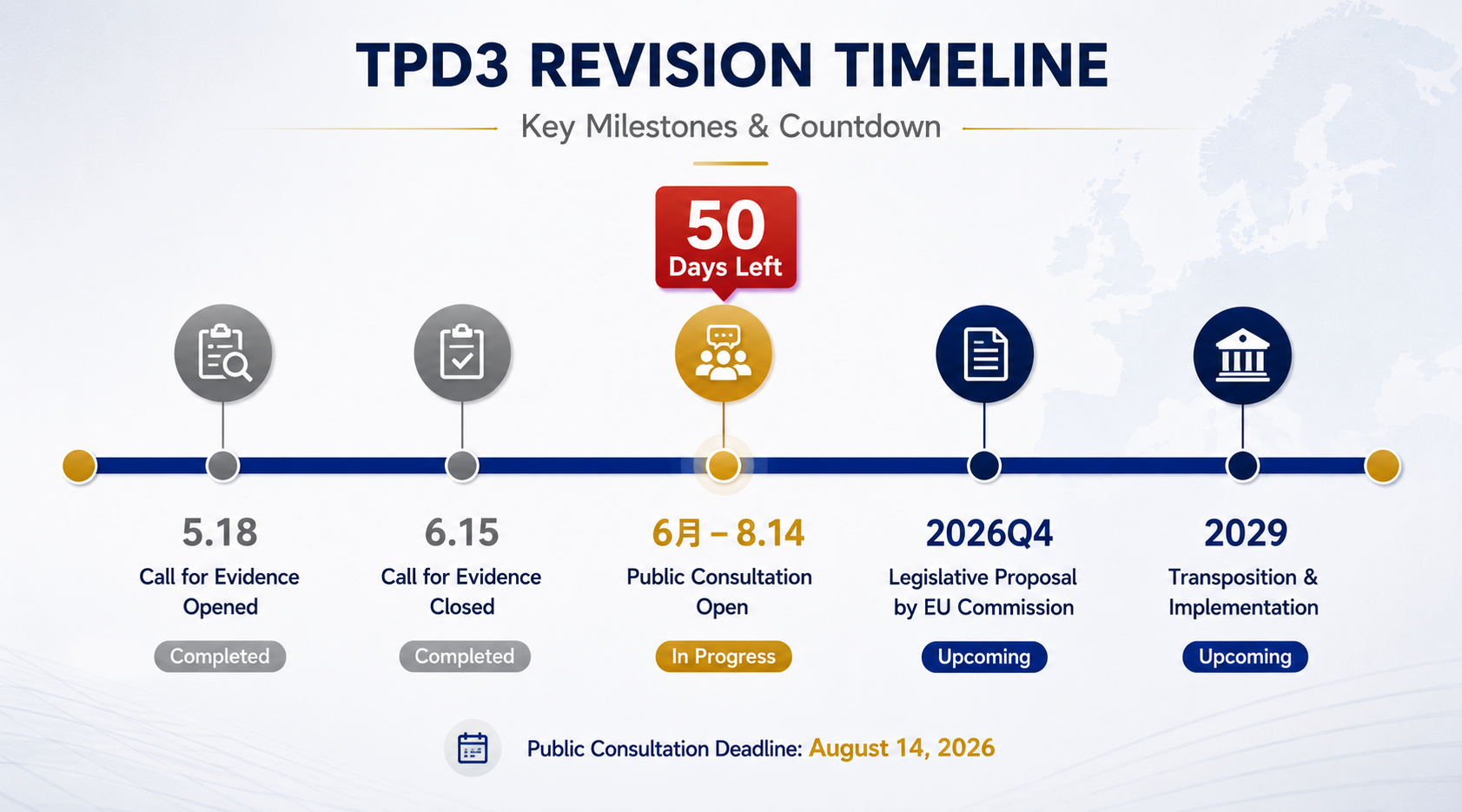
The revision process began on May 18, when the European Commission launched its Call for Evidence, which has now concluded. The policy has officially moved into its public consultation stage — a critical window for industry stakeholders to provide feedback before formal legislative proposals are drafted.
Over the past ten years, the European vaping market has evolved dramatically. Disposable devices have surged, nicotine pouches have become one of the fastest-growing product categories, flavor innovation has accelerated, and cross-border e-commerce has expanded rapidly.
Yet the current TPD framework was built for a very different market.
Now, regulators are preparing to catch up.
At the compliance seminar hosted by the Electronic Cigarette Committee of the China Electronics Chamber of Commerce on June 9, experts from Taramind Intelligence (UK), ARAC (US), and multiple international regulatory specialists all pointed to the same conclusion:
The EU is preparing for a much broader and stricter regulatory era.
For Chinese manufacturers exporting to Europe, this is no longer just a regional policy update — it is a major strategic signal.
1. The Core Directions of TPD3
Based on the European Commission’s consultation documents and recent policy signals, the industry widely refers to this revision as TPD3.
So far, four major directions have become increasingly clear:
Expanding Scope: From “Tobacco Products” to “All Nicotine Products”
Current TPD rules primarily regulate nicotine-containing vaping products.
The upcoming revision is expected to broaden the scope to cover:
- Nicotine pouches
- Nicotine gums and lozenges
- Non-nicotine e-cigarette products currently outside unified regulation
This means a much larger category of products could soon fall under mandatory ingredient disclosure, product notification, and market authorization requirements.
Closing Existing Regulatory Loopholes
Over the past few years, many products have been designed specifically to work around current TPD limitations.
Key loopholes under review include:
- “2+10” combo systems (2ml pod + 10ml refill bottle)
- “Zero nicotine” products that can be mixed with nicotine later
- Regulatory inconsistencies in cross-border online sales
The goal is straightforward:
Reduce regulatory arbitrage.
Harmonizing Product Standards Across the EU
One major criticism of the current TPD is its fragmented implementation across member states.
The revision may push for stronger alignment on:
- Nicotine concentration limits
- Emission standards
- Harmful substance limits
- Packaging warnings
- Product notification procedures
One topic gaining significant momentum is Plain Packaging, which could dramatically reduce brand differentiation at the packaging level.
Tightening Channel and Marketing Controls
Beyond product standards, TPD3 may also significantly strengthen sales and marketing restrictions.
Potential measures include:
- Stricter age verification systems
- Stronger controls on digital marketing and social media promotions
- Clearer boundaries for influencer and KOL collaborations
- Enhanced product traceability requirements
For brands heavily dependent on online acquisition, this may be one of the most immediate impacts.
2. Key Timeline
According to the European Commission:
| Stage | Timeline |
|---|---|
| Call for Evidence | May 18 – June 15, 2026 (Completed) |
| Public Consultation | June – August 14, 2026 (Ongoing) |
| Formal Legislative Proposal | Expected Q4 2026 |
| Parliamentary & Member State Review | Expected 2027 |
| Earliest Implementation | Around 2029 |
The initial evidence collection phase alone received over 82,000 submissions, highlighting the intense attention this revision has attracted across Europe.
For businesses, the current consultation phase remains one of the few opportunities to influence the final direction.
3. EU Member States Are Becoming Increasingly Divided
Recent developments show that regulatory positions among EU countries are diverging quickly.
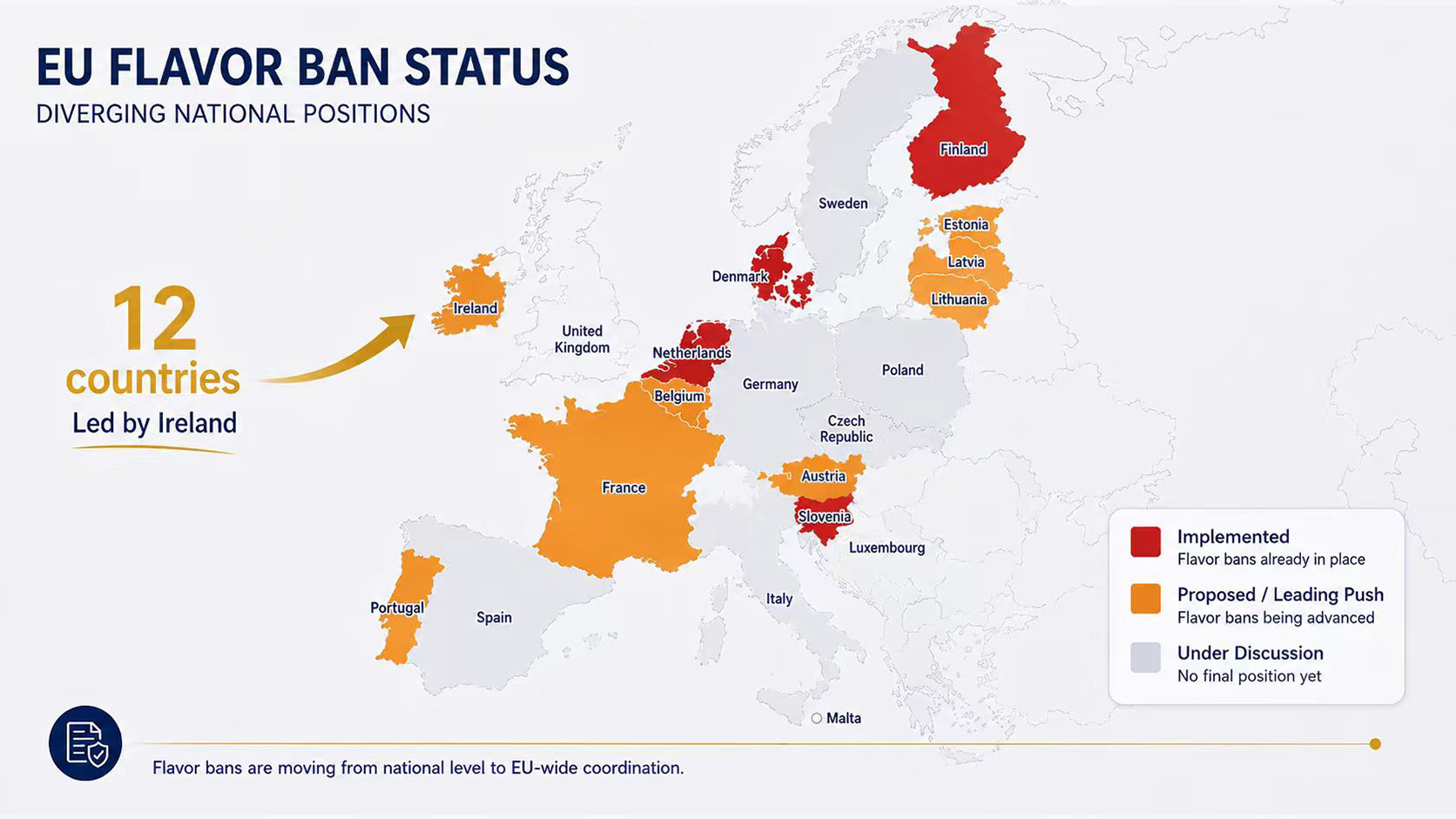
On June 20, during the EU Health Council meeting, a coalition of 12 member states led by Ireland pushed for:
- A comprehensive ban on e-liquid flavors
- EU-wide plain packaging requirements
- Stronger unified controls on cross-border sales
This signals something important:
Flavor restrictions are moving from isolated national policies toward potential EU-wide coordination.
Meanwhile, France has proposed even stricter measures, including:
- Full flavor bans
- EU-level plain packaging
- Lower nicotine caps
- A ban on cigarette filters
Several countries including Denmark, the Netherlands, Belgium, Finland, and Slovenia have already implemented or are actively advancing flavor restrictions.
The direction is becoming increasingly clear.
4. The Bigger Industry Battle: Public Health vs Economic Impact
Behind the TPD revision lies a much bigger debate.
On June 23, PMI CEO Massimo Andolina sent a letter to European Commission President Ursula von der Leyen, urging the EU to recognize the economic role of nicotine-related industries.
According to PMI:
- The sector supports 2.1 million jobs across Europe
- It involves over 45,000 SMEs
- It contributes around €180 billion annually in tax revenues
At the same time, public health organizations such as the Smoke Free Partnership (SFP) continue pushing for stronger restrictions on emerging nicotine products.
This ongoing tension means the final TPD3 framework remains highly uncertain.
5. What This Means for Chinese Exporters
Once implemented, TPD3 could create several major impacts:
Rising Compliance Costs
Testing, toxicological assessments, packaging adaptation, and notification requirements will likely become more expensive.
Reduced Product Flexibility
Large-capacity designs, combo systems, and certain flavor categories may face tighter restrictions.
Longer Market Entry Timelines
Approval processes and product launch cycles could become significantly longer.
Faster Industry Consolidation
The EU market will increasingly favor manufacturers with:
- Stronger compliance systems
- More stable supply chains
- Mature delivery capabilities
6. What Should Businesses Do Now?
Preparation should start now.
Key priorities include:
Participate in Public Consultation
Businesses can still submit feedback before August 14, 2026.
Conduct Internal Compliance Reviews
Focus on:
- Product structure risks
- Packaging adaptability
- Ingredient documentation
- Toxicological readiness
Monitor Key Markets Closely
Especially:
- France
- Germany
- Italy
- Belgium
- Netherlands
These markets often signal where EU policy may head next.

How YTOO Supports Partners Through Regulatory Change
At YTOO, we continue to closely monitor global regulatory developments and support our partners through evolving compliance requirements.
So far, we have helped clients with:
✅ TPD registration
✅ UFI coding
✅ Toxicological assessments
✅ UK VPD tax stamp packaging adaptation
As Europe enters a new regulatory cycle, we remain committed to providing:
- Timely regulatory insights
- Compliance-ready product development
- Market entry support for EU and UK markets
Compliance is not a barrier — it is the passport to mature markets.
If you have questions about EU compliance, TPD registration, or product development for Europe, feel free to contact us.
📩 Business Contact: info@ytoojuice.com